
The future of education is digital — but for millions of Nigerian children, that future feels distant. Nigeria, with its fast-growing population of over 229 million, is at a critical learning crisis. According to UNICEF, an estimated 10.5 million Nigerian children are out of school. Those who do attend often contend with overcrowded classrooms, inadequate infrastructure, and little to no access to technology. Even among enrolled youth, 78% lack basic digital literacy skills, leaving them unprepared for a rapidly changing world.
Against this backdrop, when Oando Foundation launched in 2011, its mission was simple: to ensure every Nigerian child, regardless of background, has access to quality education and the opportunity to thrive. Since inception, the Foundation’s initiatives have spanned school infrastructure development, teacher training, scholarships, and community engagement. Through flagship programs such as Early Childhood Care and Development (ECCD), Clean Our World, and most recently the Green Youth Upskilling Programme, Oando Foundation continues to impact thousands of children, creating enabling environments for learning while promoting sustainability and climate awareness.
In line with this, the Foundation prioritizes innovation and investments in equitable, quality, and climate-sensitive education. This commitment inspired its partnership with Teach for Nigeria (TFN) Incubation Hub Pitch Competition—a 3-month Incubation Programme that provides TFN alumni a unique opportunity to accelerate growth through their social impact projects. Now in the third year of its collaboration with Oando Foundation, the competition equips social innovators with funding, mentorship, tools, and networks to turn bold ideas into sustainable enterprises tackling challenges from EdTech and workforce development to climate change and foundational learning.
Supporting Social Innovators: From Waste to Design to Scholaride
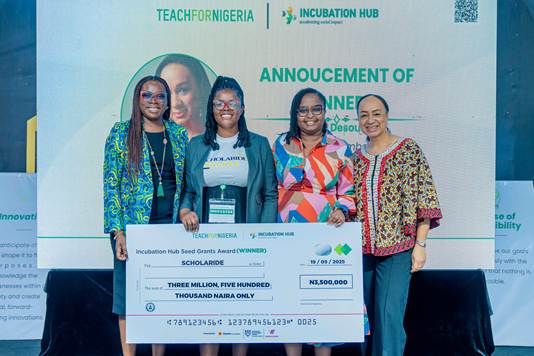
This year, Adetomiwa Awofeso emerged as the winner of the TFN Incubation Hub Pitch Competition, for her visionary initiative, Scholaride, an EdTech and Digital Learning solution. With a ₦3.5 million grant, her initiative addresses barriers to education for children in low-income and remote communities across Nigeria, where millions of students lack learning tools, proper school infrastructure and access to digital resources.
For Adetomiwa, the grant marks a step forward in her mission to empower children through learning. “Winning the 2025 Teach for Nigeria Incubation Hub Pitch Competition was a milestone for me and my work at Scholaride Initiative. I am deeply grateful to Oando Foundation for their unwavering commitment to supporting young innovators in education. Scholaride is committed to bringing the Makoko children out of poor literacy and numeracy using the TaRL methodology with our Learning Hub. Oando Foundation’s investment is not just in us as individuals, but in the future of countless children who will benefit from the ideas. Thank you for believing in our vision and for your partnership with Teach for Nigeria as we strive to transform education in underserved communities.”
By 2029, Scholaride aims to reach 100,000 students through its digital platform and grassroots interventions, creating lasting impact through a blend of innovation, sustainability, and collaboration. To get there, Adetomiwa is diversifying funding, adopting a freemium model for the platform, and building partnerships to ensure that Scholaride grows well beyond its beginnings.
Adetomiwa’s win continues a tradition of bold, youth-led innovation supported by the Oando Foundation. Just last year, Collins Nnabuike won the 2024 pitch competition with Waste to Design, a project that turns plastic waste into school furniture and learning materials. What started as an “impossible” idea is now furnishing classrooms in underserved communities while tackling Nigeria’s mounting plastic pollution problem. For Oando Foundation, this partnership with Teach for Nigeria reflects its broader LEARNOVATE strategy, centred on improving foundational learning through innovative approaches and promoting sustainability within educational systems. A key component, PLANET, focuses on the promotion of environmental education, green skills development, and waste management initiatives at the basic education level. By equipping pupils, teachers, and communities with knowledge of sustainable practices, LEARNOVATE aims to create environmentally conscious future leaders while enhancing educational outcomes.